


Overview of Non – Stick Spraying Process and Related Solutions
- Introduction to Non – Stick Spraying
Non – stick spraying falls under the high – temperature spraying category and is applicable to items like cake plates, non – stick pots, and rice cooker inner gallbladders. The main spraying methods are internal spraying and external spraying. - Process Flow
General Pretreatment Flow
The general pretreatment process for parts is as follows: Upper parts → Sandblasting → Rotating parts → Water washing & sand removal → Alkali washing → Water washing → Pure water washing → Blowing → Drying → Cooling → Next part.
Internal Coating Process
-Topcoat stage:
- Automatic dust removal.
- Preheating.
- Spraying primer.
- Surface drying.
- Cooling.
- Spraying top coat.
- Surface drying.
- Turning parts.
Heating and Sintering:
- Upper High Temperature Line.
- Low Temperature Volatilization.
- High Temperature Sintering.
- Cooling.
- Lower Parts.
External Coating Process
- Initial treatment:
- Top – Automatic Dust Removal.
- Preheating.
- Primer Spray.
- Transformer (It’s not clear what “transformer” means here; might be a misnomer or an unclear step. It could potentially be a transfer step).
2. Heating and Sintering:
- Top High Temperature Line.
- Low Temperature Volatilization.
- High Temperature Sintering.
- Cooling.
- Lower Parts.
These processes are generally similar and can be adjusted appropriately and simply.
- Ensuring High Product Qualification Rates
Most non – stick paint automatic spraying lines need to achieve a product qualification rate of over 95% for customers. To address this, our company, after gathering and summarizing experience from multiple production lines, has jointly developed the following with customers:
Stable Conveying System
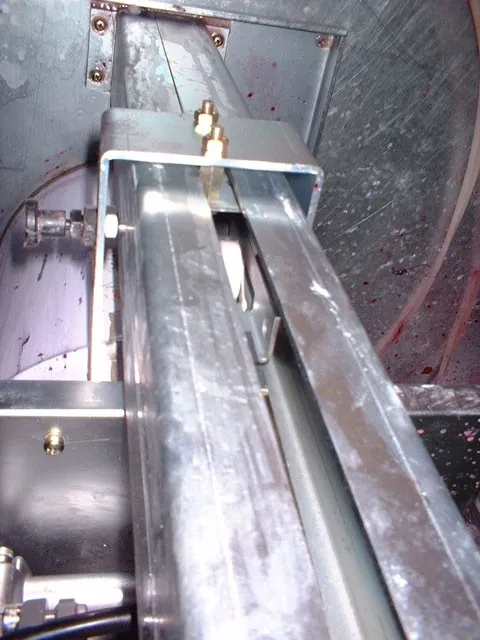
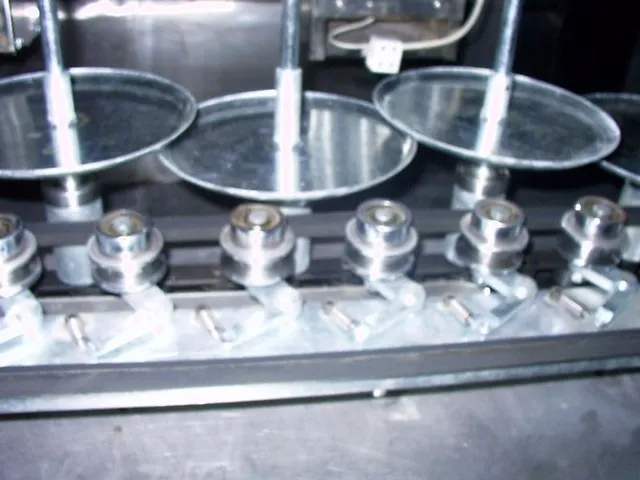
The automatic line conveyor chain is made of knurled aluminium alloy, with a bearing in the middle. When the fixture is assembled on the chain, side rails on both sides of the bearing position clamp the bearing. This prevents product shaking and chain misalignment, which is especially important for large and heavy products.
10,000 – Grade Dust – Free Air – Supply System
- Components:
- Quick – disassembly air – supply cabinet (all – aluminium alloy with bolt connections).
- An internal filtration system consisting of primary, medium, and sub – high – efficiency filters, with a high – efficiency filter as the final stage.
2. Performance:
- Although it may not reach the 1000 – grade level in a static state, the entire filter system is designed for easy disassembly, allowing for quick filter replacement.
3. Spraying Methods
Robot Spraying
The line speed for robot spraying should be 1 – 3 m/min. If it’s too fast, the robot can’t keep up due to its limited spraying efficiency.
Fixed – Gun Automatic Spraying
It results in more paint waste but has a relatively high efficiency, with a line speed that can reach about 5 meters per minute.
Reciprocating Tracking Spraying
It can be planar reciprocating tracking or fixed – gun reciprocating tracking. We select suitable spraying methods based on customer productivity requirements and product complexity. If one set of tracking is insufficient, an additional set of the spraying system can be added. This method is more flexible than fixed – gun spraying, ensuring both production efficiency and product quality.
4. Product Drying Forms
Product drying methods are diverse and include medium – wave infrared heating pipes, far – infrared radiation heating, and natural gas heating.
Furnace Design for Stable Temperature
To maintain a smooth and stable temperature curve, if necessary, the furnace can be equipped with a self – rotating device. The automatic line dryer has an overhaul door at intervals. These doors are set in an opposite and offset mode and can be made into fully open doors for easy maintenance.
The high – temperature sintering furnace should be separated from the automatic spraying line. The high – temperature sintering line can be divided into two sections: one at 180 – 220 degrees and the other at 220 – 450 degrees. To ensure a stable furnace temperature curve, the furnace body should be made as short as possible, and the humidity around the furnace body should be strengthened. Lifting doors are installed at both ends of the entry ports to prevent heat overflow.